How to compare agents on six things
Agents look identical on their homepages. They differ on six measurable things, and only one of them is the number they advertise.
The six things worth comparing
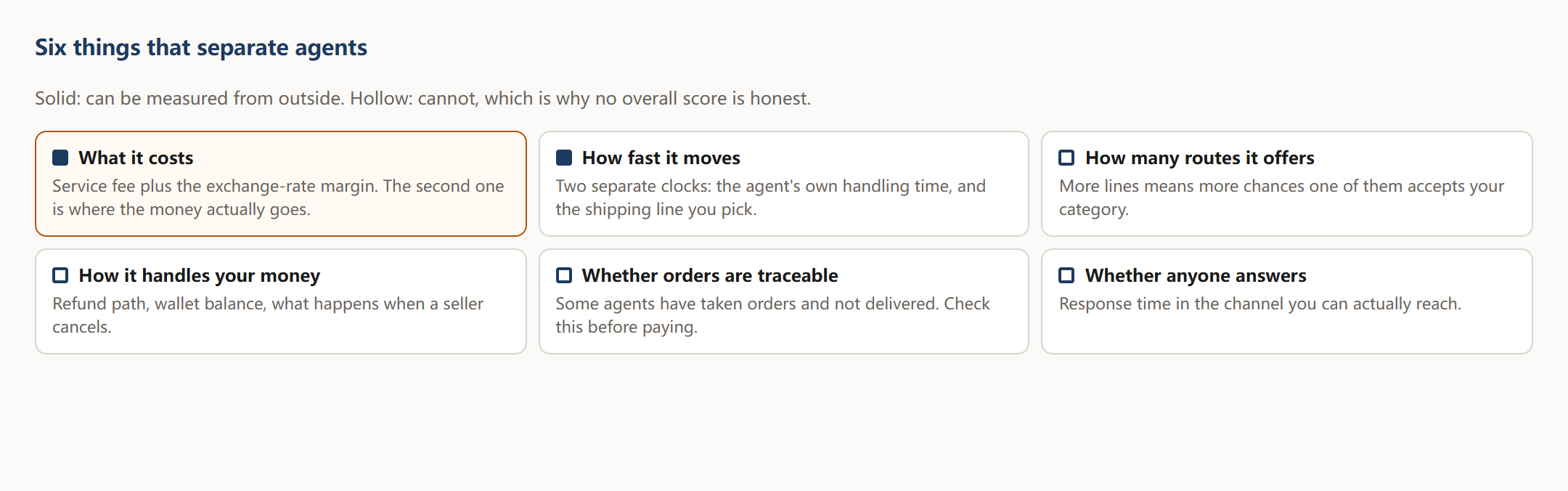
Everything else is marketing. In rough order of how much it will affect you:
- What it costs. Service fee plus the exchange-rate margin. The second one is where the money actually goes.
- How fast it moves. Two separate clocks: the agent's own handling time, and the shipping line you pick.
- How many routes it offers. More lines means more chances one of them accepts your category.
- How it handles your money. Refund path, wallet balance, what happens when a seller cancels.
- Whether orders are traceable. Some agents have taken orders and not delivered. Check this before paying.
- Whether anyone answers. Response time in the channel you can actually reach.
Note what is missing. There is no overall score here and there will not be one. Scoring agents against each other requires data nobody publishes, and inventing it would be worse than useless to you.
Fees carry the most weight
Fees: the advertised number is the wrong number
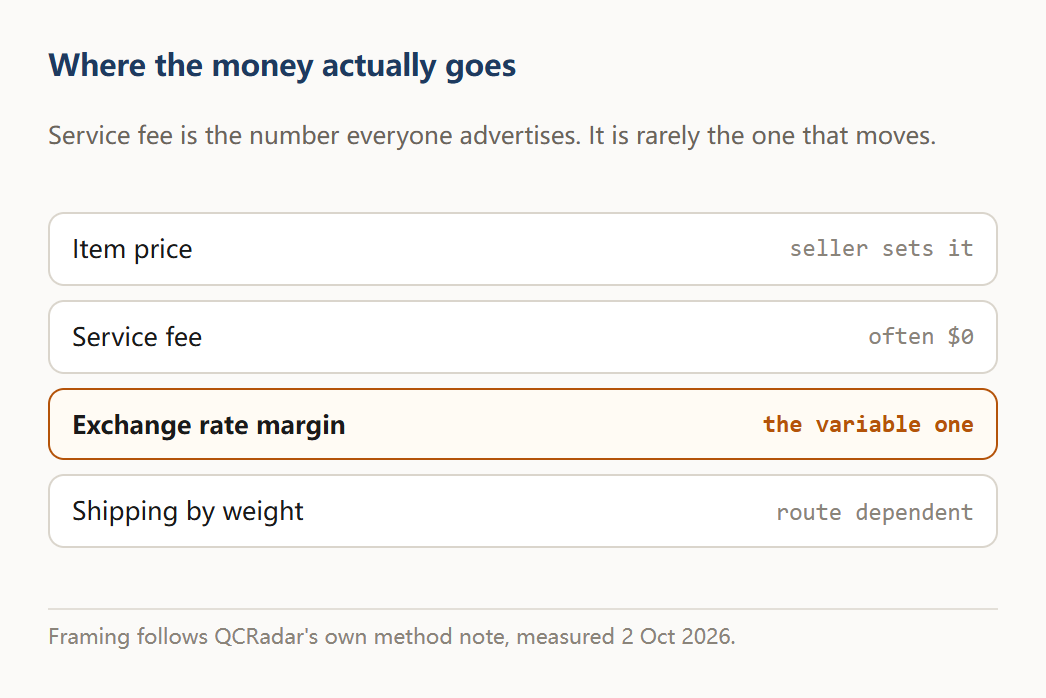
Almost every agent now advertises no service fee on standard platforms. When everyone claims the same thing, the claim stops separating anyone.
The cost that actually varies is the exchange rate. Each agent converts your total at its own rate, and the gap over the mid market rate is a margin that appears nowhere on the checkout page. The dated comparison sample places the spread at roughly zero to twenty five percent. Spread, sampled on 2026-10-02.
So the question to ask is not what the service fee is. It is what rate they convert at, and the way to find out is to put the same basket through two accounts and compare the totals.
Numbers move, so do not memorise them
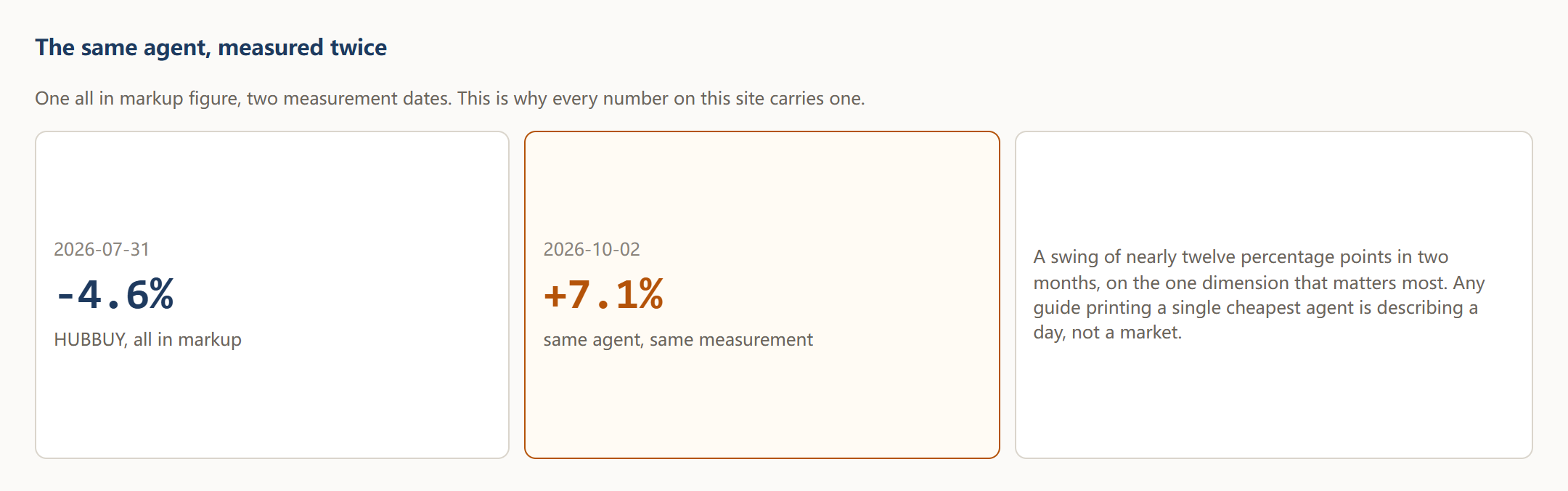
Here is why this site prints a date next to every figure. One agent's all in markup was -4.6% when measured on 2026-07-31 and +7.1% when measured again on 2026-10-02. That is a swing of nearly twelve percentage points in two months, on the single dimension that matters most.
Any guide that prints a cheapest agent and leaves it there is describing a day, not a market. Check the figure yourself near the time you order.
The source these figures come fromThird party
Risk signals, and what each one is actually evidence of
A third party reviewer currently flags two agents for extra order verification before paying, and is careful to call it a neutral caution rather than an accusation. That is the right posture and this site copies it: these are signals to check, not verdicts.
No traceable order recordYou cannot see what was bought on your behalf. This is the one that matters most.Pressure to pay outside the platformMoves the transaction somewhere with no record and no recourse.No recent QC photographsCould be a quiet week. Could be that items are not being checked. Ask.Warehouse terms that are hard to findStorage limits and disposal rules should not require hunting.No named operating company anywherePlenty of legitimate operations are thin on this. It raises the cost of a dispute.A published, dated fee structureA good sign. It means the number can be held against them later.
the link answers this someone has to tell you nothing here can answer it
Before you commit
A checklist before you commit to one
Run this once, when you open the account, not every order:
- Put an identical basket through two agents and compare the final totals, not the fees.
- Find the storage policy and read what happens when the window ends. Disposal is a real outcome at some warehouses.
- Find the refund path for the case where a seller cancels after payment. It should not require a support ticket to discover.
- Send one question through their support channel and time the reply.
- Check which platforms they support. Weidian support is not universal, so confirm it rather than assume it. LoongBuy, for instance, states it in its own page title.